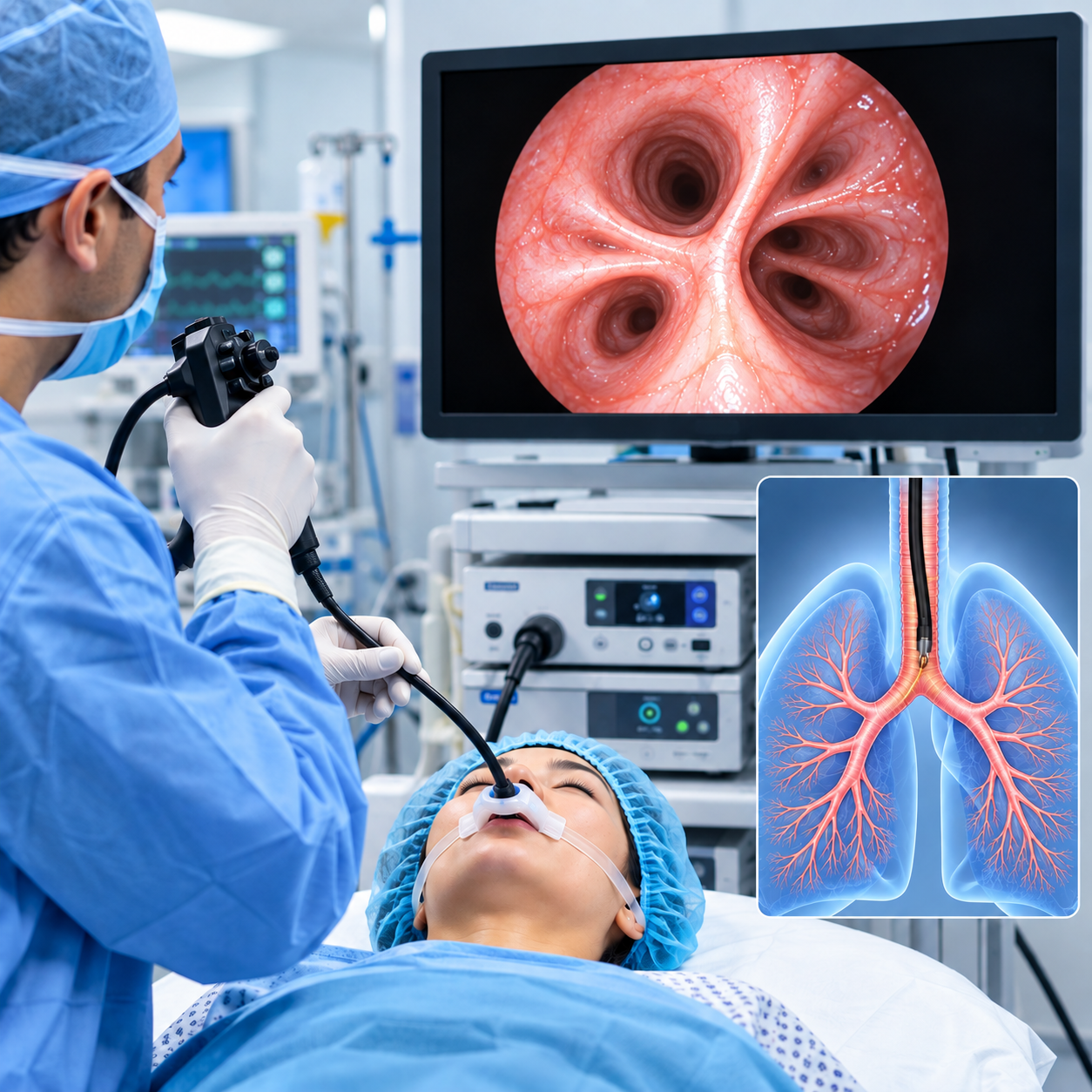
Bronchoscopy
Advanced Bronchoscopy for Accurate Lung and Airway Diagnosis
Bronchoscopy is a minimally invasive procedure that allows a pulmonologist to examine the inside of the windpipe and airways using a thin, flexible tube called a bronchoscope. The bronchoscope has a camera and light that provide a clear view of the respiratory passages and can also be used to collect tissue, mucus or fluid samples for laboratory testing.
Dr. Aastha Gupta, Consultant Pulmonologist and Interventional Pulmonologist, provides specialized bronchoscopic evaluation and advanced respiratory care for patients with complex lung and airway conditions.
What Is Bronchoscopy?
During a flexible bronchoscopy, the bronchoscope is carefully introduced through the nose or mouth, passed through the voice box and into the trachea and bronchi. The procedure enables the doctor to directly inspect the airways and identify abnormalities that may not be fully evaluated through imaging alone.
Depending on the patient's condition, additional procedures such as biopsy, bronchial washing, bronchoalveolar lavage (BAL), brushing or transbronchial biopsy may be performed during the same session.
Why Is Bronchoscopy Performed?
Bronchoscopy may be recommended to investigate persistent respiratory symptoms, abnormal imaging findings or suspected diseases affecting the airways and lungs.
Common indications include:
- Persistent or unexplained cough
- Coughing up blood (hemoptysis)
- Abnormal chest X-ray or CT scan
- Suspected lung cancer
- Recurrent or difficult-to-diagnose respiratory infections
- Unexplained lung inflammation
- Airway narrowing or obstruction
- Evaluation of abnormal lung or airway lesions
- Removal of selected foreign bodies or airway secretions
The exact indication depends on the patient's symptoms, imaging findings and clinical assessment.
Bronchoscopy for Lung Cancer Diagnosis
Bronchoscopy can be an important part of the diagnostic evaluation of suspected lung cancer. Abnormal areas within the airways can be examined and tissue or cell samples can be collected for pathological analysis.
Depending on the location of the abnormality, techniques such as endobronchial biopsy, brushing, washing or transbronchial biopsy may be used. The collected samples are examined in the laboratory to help establish a diagnosis.
Bronchoalveolar Lavage (BAL)
Bronchoalveolar lavage, or BAL, is a sampling technique performed during bronchoscopy. A small amount of sterile saline is introduced into a selected area of the lung and then collected for laboratory analysis.
BAL may help investigate lung infections, inflammation and certain diffuse lung conditions.
How Is Bronchoscopy Performed?
Flexible bronchoscopy is commonly performed using local anaesthesia to numb the nose and throat, often together with sedation to help the patient remain relaxed and comfortable. Oxygen levels and other vital signs are monitored during the procedure.
The bronchoscope is gently guided into the airways, allowing the pulmonologist to examine the respiratory passages and perform any required sampling or intervention.
Benefits of Bronchoscopy
Bronchoscopy provides several important advantages:
- Direct visualization of the airways
- Minimally invasive tissue and fluid sampling
- Helps investigate unexplained respiratory symptoms
- Supports diagnosis of lung cancer and infections
- Enables BAL and airway sampling
- Can assist with selected airway interventions
Recovery and Aftercare
After bronchoscopy, patients are usually monitored until the effects of sedation and local anaesthesia have reduced. A mild sore throat, cough or small amounts of blood-streaked sputum can occur after sampling and are generally temporary.
Patients should follow their doctor's specific instructions regarding eating, drinking, medications, driving and other activities after the procedure.
Bronchoscopy by Dr. Aastha Gupta
Dr. Aastha Gupta provides specialized interventional pulmonology and bronchoscopy services for the diagnosis and management of complex lung and airway conditions.
If you have a persistent cough, coughing up blood, recurrent respiratory infections or an abnormal chest scan, bronchoscopy may be recommended to obtain a more detailed evaluation and, when necessary, tissue or fluid samples for diagnosis.