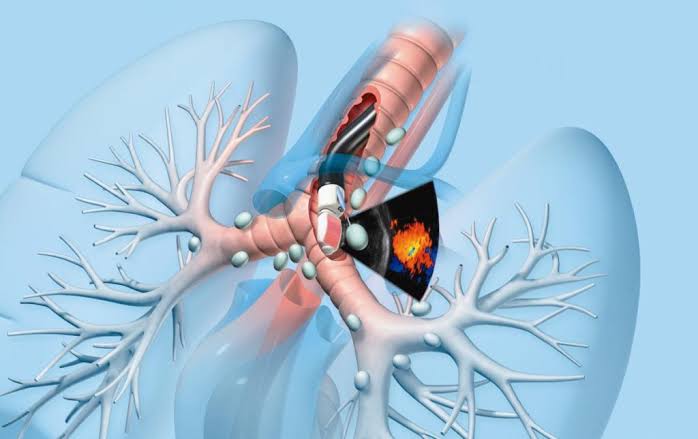
EBUS-TBNA
Advanced EBUS-TBNA for Accurate Lung and Lymph Node Diagnosis
EBUS-TBNA (Endobronchial Ultrasound-Guided Transbronchial Needle Aspiration) is a minimally invasive bronchoscopic procedure used to examine structures around the airways and obtain tissue or cell samples from lymph nodes and other areas within the chest. It combines bronchoscopy with ultrasound imaging, allowing the pulmonologist to identify and sample targeted areas under direct guidance.
Dr. Aastha Gupta, Consultant Pulmonologist and Interventional Pulmonologist, provides specialized bronchoscopic evaluation and EBUS-TBNA for patients requiring detailed investigation of lung and mediastinal conditions.
What Is EBUS-TBNA?
During an EBUS-TBNA procedure, a thin, flexible bronchoscope with a camera and ultrasound probe is passed through the mouth into the windpipe and airways. The ultrasound helps visualize lymph nodes and structures located outside the airway walls.
A fine needle passed through the bronchoscope is then used to collect samples from selected lymph nodes or lesions. These samples are sent to the laboratory for microscopic and other appropriate testing.
Why Is EBUS-TBNA Performed?
EBUS-TBNA is commonly recommended when imaging such as a CT scan or PET-CT shows enlarged or abnormal lymph nodes or other areas that require further evaluation.
The procedure can help doctors:
- Investigate enlarged mediastinal or hilar lymph nodes
- Evaluate suspected lung cancer
- Assist with lung cancer staging
- Investigate conditions such as sarcoidosis
- Support evaluation of tuberculosis and other inflammatory or infectious conditions
- Obtain tissue samples without requiring a more invasive surgical biopsy in appropriate patients
The exact reason for EBUS-TBNA depends on the patient's symptoms, imaging findings and suspected diagnosis.
EBUS-TBNA for Lung Cancer Diagnosis and Staging
EBUS-TBNA can play an important role in the evaluation of suspected lung cancer. Sampling lymph nodes in the central chest can help determine whether cancer has spread to these lymph nodes and can contribute to accurate staging.
Tissue or cell samples may also provide material for additional laboratory testing when required to help guide treatment decisions.
How Is EBUS-TBNA Performed?
EBUS-TBNA is generally performed using local anaesthetic and sedation, depending on the patient's condition and the medical centre's protocol. The bronchoscope is carefully introduced through the mouth and into the airways.
The ultrasound probe identifies the target lymph nodes or lesions, after which a fine needle is used to collect samples. The patient's oxygen levels and vital signs are monitored during the procedure.
Benefits of EBUS-TBNA
EBUS-TBNA provides several important advantages:
- Minimally invasive sampling
- Real-time ultrasound guidance
- Access to lymph nodes within the chest
- Helps support diagnosis and staging
- May reduce the need for more invasive surgical sampling in suitable patients
- Can provide samples for pathological and other laboratory evaluation
Recovery and Aftercare
Patients may experience a mild sore throat, cough or a small amount of blood in the sputum after the procedure. These symptoms generally settle, but patients should follow their doctor's specific aftercare instructions. Because sedation may be used, patients generally need assistance getting home and should follow instructions regarding driving and other activities afterward.
EBUS-TBNA by Dr. Aastha Gupta
Dr. Aastha Gupta provides specialized interventional pulmonology and EBUS-TBNA services, with a focus on accurate diagnosis of lung and mediastinal conditions.
If you have enlarged chest lymph nodes, an abnormal lung scan or suspected lung cancer, EBUS-TBNA may be recommended as part of a comprehensive diagnostic evaluation.